
With all the brouhaha over GST, and (often) a limited understanding of the long-term forces shaping India's logistics sector, companies seem to have omitted factoring in some underlying trends that could shape supply chain excellence, says Neelesh Mundra.

Colonel Anil Athale (retd) recalls how the Battle of Panipat, 258 years ago, changed the history of India for the next century and half.
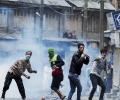
'Burhan Wani's killing served as a spark for the anti-establishment fire that has been raging in the minds of Kashmiris ever since the Centre stopped engaging them for their political future,' says Air Vice Marshal (retd) Kapil Kak in an interview with Rediff.com

'The military officers at China's National People's Congress reflect Xi Jinping's preference for elevating politically reliable, younger, officers with good professional qualifications,' says former RAW officer and China expert Jayadeva Ranade.

Cyberspace is a battleground as important as the traditional domains of air, land, sea and space, says US Defence Secretary Ash Carter, who visits India next week.

'China any day would prefer to team up with India and dump Pakistan once the resolution of the border dispute becomes an accomplished fact.'
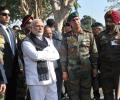
'The attack on the Pathankot base constituted an act of war. Yet Modi's only public comment up until now on that attack has been to blame it on "enemies of humanity".' 'Modi came to power talking tough about Pakistan. But in office, he has pursued a Pakistan policy that has lost both direction and purpose,' argues Brahma Chellaney.
'We should not treat each other as rivals. We should make cooperation the mainstream, China said.

Rajaram Panda explains why the US president needs to restrain himself and build a relationship with China to put any credible pressure on North Korea.

Considering Modi's style of practicing diplomacy, it is likely that a clear message would be conveyed to China that it is high time Beijing stops using its good relations with Pakistan as a pressure tactic against India. This is imperative not only for strengthening India-China relations at the bilateral level but also for maintaining stability at the regional level, says Sana Hashmi.

BJP, AIADMK oppose the project while DMK and CPI(M) support the Sethusamudram shipping project across the Palk Strait. T E Narasimhan reports

'During his visit to Vietnam on September 3 -- the first visit by an Indian prime minister in 15 years -- Modi will notice the widespread anti-China sentiment in that country.'

Finance Minister Arun Jaitley on his maiden visit as minister to Washington, DC, addresses two think thanks, leaves American Establishment impressed, reports Aziz Haniffa/Rediff.com.
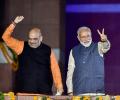
Modi and Shah's next focus will be South India, and the Maharashtra and Jharkhand assembly elections. Shah is unlikely to abdicate control over the party even after he joins the government. Modi and Shah both know only too well that the party makes the government, and not the other way round.

The rising popularity of Heritage Walks is uncovering forgotten historic sites all over India.
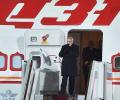
During his two day visit, Modi is expected to seal a raft of major deals in defence, nuclear energy and hydrocarbons sectors to further cement their 'special and privileged strategic ties'.

The BRICS summit made clear that China's support for Pakistan is unwavering. China will continue to pressure India to ease tensions with Pakistan and resolve the Kashmir dispute.

'Pakistan will try to escalate covert operations through terrorism,' says Dr Shalini Chawla.
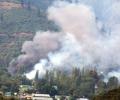
'Knee jerk reactions are the worst in this kind of conflict situation.' 'The responses have to be thought through for strategic advantage rather than tactical satisfaction and ego,' says Lieutenant General Syed Ata Hasnain (retd), former commander of the Uri-based Kalapahar Brigade.

India's full membership of the grouping would extend its reach to the Central Asian region in whose peace and stability it is a major stakeholder, says Sana Hashmi.
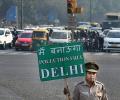
Friday will be the first day of the second phase of the odd-even scheme in New Delhi.

Asserting that "maritime muscle flexing" by some countries and other factors have made the Indo-Pacific region "more contested and more volatile," naval chief Admiral Sunil Lanba on Tuesday said that the Indian Navy has its task cut out as it has been a major security provider in the region.

'Even if such a thing happens, it will not prolong for many days like Doklam did.' 'That is because both the leaders do not want it.'

He said India can have a possible role in creating a multilateral forum of negotiations between the Palestinians and Israelis.

There are still a few lingering issues towards the progress of India-China bilateral relations, the approach for dealing with each other seems to be quite different. With Modi-Xi bonhomie strengthening, it seems that India and China are ready to recalibrate their approaches towards each other, says Sana Hashmi.

'The origins of the model of planned economic development adopted by independent India was a direct consequence of the war.' 'The war provided an opportunity for groups at the margins of Indian society to find new avenues for mobility.' 'The war also led to the emergence of India as a major Asian power and set the stage for it to play a wider role in international politics.'

Prime Minister Narendra Modi will do a repeat of his Madison Square Garden act during his next month's visit to China

'If the RSS should be saluted for choosing such a scholarly statesman to address its highly trained cadre, one must also praise Pranab Da's sagacity for having gracefully accepting the invitation, thus disapproving any ideological apartheid,' says former BJP MP Tarun Vijay.

India should enhance its economic, cultural and defence ties with Mongolia. It is high time Modi should focus on gaining clout in smaller Asian countries such as Mongolia. It is in this context, India's engagement with Mongolia would give much-needed impetus to India's foreign policy, says Sana Hashmi.
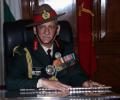
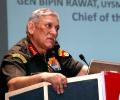
The new army chief's highest priority must be to address the critical hollowness in the Indian Army's operational preparedness, says Brigadier Gurmeet Kanwal (retd).

We must see New Delhi's position as a signal of competition to the Chinese grand design for the 21st century world, says Nitin Pai.

'If, as appears to be the case, India is on way to 'mending fences' with China, and China is equally desirous to 'reset' the relationship, this could be a self-reflexive moment in India's positioning vis-a-vis not just the Dalai Lama, but also the Tibetan issue and China as a whole,' points out China expert Alka Acharya.
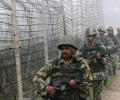
'For every act of terrorism on Indian territory for which there is credible evidence pointing to the Pakistan army and the ISI's involvement, carefully calibrated military strikes must be launched against the Pakistan army,' says Brigadier Gurmeet Kanwal (retd).

Former Watson Fellow and social entrepreneur Srikar Gullapalli talks about the issues affecting India's growth and tells us why he wants more people to actively participate in building a bright future and put India on the global map.
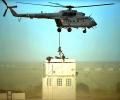
'While US officials understand and accept India's desire for retaliation, they still don't want to encourage steps that would likely lead to war.'

'This novel format of diplomacy -- the informal summit -- will not only facilitate bilateral communication and reduce miscalculations at the very top level of the two governments, but possibly open the space for China and India to speak in one voice on various issues of mutual concern,' note Feng Renjie and Ding Kun Lei

'I couldn't think of a more visible strategic form of cooperation than both of our armed serves using a similar weaponry jointly developed together.' Aziz Haniffa/Rediff.com reports from Washington, DC on what is expected in the India-US defence relationship during Prime Minister Modi's visit.
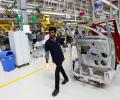
Technology and operations management expert Elliott N Weiss discusses manufacturing, the trouble with too much automation, and the need to strike a balance between people and artificial intelligence with Ritwik Sharma.

While China is bigger and feels mightier at the moment, Beijing's rulers would be well advised not to be tempted to provoke India, for that would only trigger a chain reaction around the world that would not serve anyone's interests, says Sanjaya Baru.

Being a pragmatist Modi is not likely to give preference to China over Japan. Both security and economic aspects are likely to shape Modi's decision in terms of engaging the two biggest economies of Asia, says Sana Hashmi.
